kenny hodgart


Leave a comment

An interview with Yao Ming

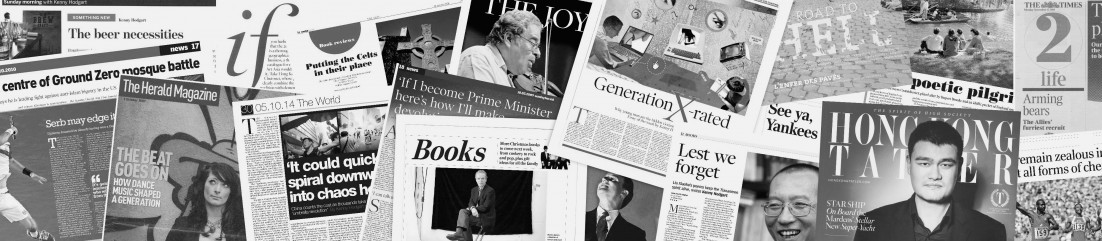
A version of this article appeared in Hong Kong Tatler

Yao Ming isn’t for talking about his basketball career today. Not directly, anyway. That’s the message from his phalanx of PR go-betweens – and the man whom the sport made probably the world’s most famous living Chinese before his retirement a year ago this month is on it.

Okay, so it seems a bit like talking to Steven Spielberg and not asking about films but let’s roll with this. China’s most feted athlete (and until recently its wealthiest celebrity, according to Forbes magazine) has long been exercised by matters other than his own greatness, whether on or off the basketball court. And he has often seemed a more complex individual – private, considered, even at times conflicted – than his very public, billboard-friendly image might suggest.

His reluctance to dwell on the past, then, speaks of what, exactly? “Slightly, I feel like I wish I still played basketball,” is all he offers when Tatler disobeys instructions by venturing to ask whether or not he regrets his career ending – at the relatively tender age of 30 – following a gruelling sequence of injuries to his feet and ankles. So there may be lingering dismay, but what else? In another interview recently Yao spoke of how being a celebrity sportsman created “discrepancies with real life”. Not the kind of insight you’d expect from, say, David Beckham, but a smart reflection, certainly, on the realm of stardom which they both, and few others from the world of sport, inhabit.Those who become, for want of a better phrase, “public property” without necessarily asking for it often find their predicament self-alienating. And there can be little doubt Yao knows the feeling: no extrovert by nature, he is forced to live in a world that offers few hiding places when you’re 7’6″ tall and everybody knows your face.

Be that as it may, there is a very clear sense that in “retirement” he wishes to take fuller ownership of the Yao Ming brand. His request, last August, to have his nomination for induction into the Naismith Basketball Hall of Fame put on hold on the grounds that it was “too soon” is one indication of that. His restlessness in terms of applying himself to other endeavours since is another. “Former NBA star Yao Ming” might always be the calling card but there will be no resting on laurels.

Right now, the focus is seemingly on building on the charitable work Yao has involved himself with for a number of years. “It’s taking up a lot of my time after basketball,” he says of his own Yao Foundation and his partnerships with a network of other philanthropic organisations.

His visit to Hong Kong, arranged in collaboration with local businessman and socialite Moses Tsang, finds him participating in a charity basketball event for children and families in order to raise funds for the international conservation charity Rare. According to the literature, the Yao-Rare partnership aims to engage “an army of young, motivated conservation ambassadors” across China.

“We share the same dream of making a difference in the world,” says Yao, stretching out his enormous frame on a suddenly incommodious-looking drawing-room chair on the top floor of Upper House in Admiralty. “I share Rare’s vision of protecting the environment and young people have to be [the guardians] of that.”

The desire to “make a difference”, or, if you like, “give something back”, is hardly new to him. In his first off-season as a Houston Rockets player, in 2003, he responded to the SARS pandemic by hosting a telethon in Shanghai to raise funds for treatment and research. His now longstanding involvement in HIV and Aids advocacy and awareness campaigns began soon after and in 2007 he held an auction that raised ¥6.75million for underprivileged children. Later, after the 2008 Sichuan earthquake, he donated US$2million to relief work and established the Yao Foundation to help rebuild schools destroyed in the catastrophe.

Since then the foundation has funded the construction of 14 schools in rural areas and improved facilities at many others, including installing computer rooms and equipment, libraries, sports and exercise areas and kitchens. And this year sees the start of a new initiative: the Yao Foundation Hope Primary School Basketball Season aims to introduce the sport to thousands of youngsters across China. “Hopefully this will run for many, many years,” he says. “Basketball will always be part of what I can offer to young people.”

Can he see himself becoming more involved in the coaching side of the sport? “I
honestly don’t have experience in that aspect,” he answers, his low, deep voice competing for attention with chatter in the hotel bar. “But I try to share something with the kids I work with. What I share is what I have learnt from sport. You have to trust the guy who stands shoulder to shoulder with you, you cant just rely on yourself. You don’t want to let your team-mates down; you have to back them up and trust them to back you up the same way.”

And how do those principles apply to his own life away from basketball? “In sport, there is physical contact and competition, as well as the team work… If I am working in charity, sometimes competition has to be put to one side. You have to work together with other organisations to achieve things.”

Savvy commentators have opined that Yao’s achievements in the NBA – his incredible averages with the Rockets, his inclusion on the All-NBA Team five times – were all the more remarkable for the absence of an instinctively aggressive streak in his make-up. Sure, he learned about the pressure of competing in one of the world’s most demanding sports leagues but he also brought with him from China his own cultural standards and values and they were not found to be limiting. In the man whose proudest moment was carrying the Chinese flag and leading his country’s delegation during the opening ceremony at the 2008 Beijing Olympics, a certain Confucian selflessness and humility are widely discerned.

Many, in fact, choose to see Yao – a gentle-seeming giant with his broad, kind features – as a sort of modern-day Chinese wunderkind. But if the Yao Ming success story is intoxicating it’s only half the picture. “Sometimes it can feel like there are a billion people on my shoulders,” he once said, and little wonder.

As the stress fractures and hairline fractures, the complicated surgical procedures and the months of rehabilitation proliferated in the latter part of Yao’s NBA career, there were those who made the link with his hothousing as a youth. It is claimed the government took an interest in Yao’s sporting potential from birth: both his parents were professional basketball players. By the time he was 13 – and already 6’5″ – he was training 10 hours a day at the the Shanghai Sports technical institute.

In his unauthorised biography of Yao, Operation Yao Ming, the former Newsweek journalist Brook Larmer alleges that his parents were induced to marry in order to produce a champion. He also describes in detail the quasi-scientific “special treatment”, harsh training and relentless testing the teenage Yao endured. If it is difficult to prove the ill-effects of his railroading, it is also hard to over-estimate the pressure it exerted on him to succeed – for his family and for the country. “People love Yao Ming, but no one wants to be him,” is one of Larmer’s observations.

And yet, if Yao has cause to resent aspects of the sporting crucible from which he sprang, he does a good job of hiding it. Now based again in his native Shanghai, where he lives with his wife Le Yi – who also played basketball for China at the Olympics, in 2004 – and their two-year-old daughter, Yan Qinlei, he says: “It’s like my crib. Everything feels very comfortable in Shanghai.”

Since 2009 he has even owned his former club, the Shanghai Sharks, who were then on the verge of financial collapse. That they have continued to make losses suggests there is a philanthropic dimension to his involvement to match his charity in other areas. Meanwhile, other vehicles into which he has poured some of his estimated US$105 million personal fortune – including a restaurant in Texas, a Shenzen-listed GPS tech company, a legal music download website and the recently-launched Yao Family Wines, an “artisanal” Napa Valley wine company targetting the Chinese market – seem destined be more lucrative.

Wine is said to be a passion Yao picked up from his Houston team-mate Dikemebe Mutumbo, but like the Rockets themselves, it’s off-bounds today. Perhaps it’s understandable: time is of the essence and Yao has many balls to juggle. But still, let’s throw another pass. Are his various commercial and humanitarian endeavours enough to fill the basketball-shaped void in his life? “I’ve played basketball for the last 20 years and basketball is in my blood; but it’s still part of my life with the Sharks, and that is time-consuming,” he protests. “The Shanghai Sharks is where I came from… But it’s no competition for my charity work.” Message delivered.


Leave a comment

On the (Great Ocean) Road

A version of this article appeared in the South China Morning Post’s Post Magazine

There is only one way to see Australia. Actually, come to think of it there are several, but I’d recommend driving unless you can get a hold of a private plane, and even then you’d miss out on the spectacular minutiae of that stretch of coastline, an hour and a half south-west of Melbourne, that they call the Great Ocean Road.

They take their freedoms seriously, the Aussies, and there can be few greater freedoms than that of the open highway between Torquay, south of Geelong, and Warrnambool, 150 miles to the west. In consort with the coastal formations it skirts, the road soars and plunges, here winding along cliff tops and promontories that look out on to the Bass Strait and Southern Ocean, there dropping away from eucalyptus-covered hills to the edge of some deserted beach, now slicing inland through lush rainforest or gentle pastureland. And nary the sign of a speed camera.

If that’s not how they describe it in the books, then maybe they should hire me to write them. An ex-pat friend told me before I left Melbourne that the GOR wouldn’t seem “all that” if I’d driven round Scotland. I ignored him, called the blonde (well, she used to be blonde; since venturing to the Antipodes on a working holiday visa she has gone an indeterminate ginger colour) and told her I’d pick her up in an old MG. They gave me a Mitsubishi but she got in anyway.

And so we were off, the steel, glass and bohemian chic of Melbourne behind us, beforeus the promise of rock stacks and waterfalls, sea air and summer skies stretching out beyond an absent ozone layer, wildlife and woodlands and National Parks. Everything seemed to us amenable: well-kept roads; cheap fuel; Springsteen on the iPod.

But the Great Ocean Road is of that order of things that should give pause. It’s easy now to pitch up in a Winnebago, get a few snaps of the wife standing in front of some limestone cliffs then hit the road again; or to wander the beachfront at Lorne admiring the holiday homes that cluster the hillsides and think how perfectly genteel everything looks. How soon man forgets the travails of his ancestors, or the triumph of their genius. A century ago, these coastal communities and their idyllic surrounds were isolated and unattainable except via rough coach tracks through dense bush.

That all changed when civic-minded men decided to get up a fund to finance the building of a new road, partly as a way of ensuring soldiers returning from the First World War had employment, but also to serve as a permanent monument to Australians who had been killed in the conflict. The money was raised through private subscription and borrowing and was to be repaid by charging drivers a toll until the debt was cleared, after which the road would be gifted to the state.

Work began in August 1918 and was finally completed in 1932. The soldiers were paid 10 shillings and sixpence for eight hours’ work per day and lived in tents. They had access to a piano, a gramophone, games and newspapers and when, in 1924, a steamboat casino hit a reef near Cape Patton and had to jettison 500 barrels of beer and 120 cases of spirits, they obtained the cargo, laid down their tools and enjoyed an unscheduled two-week drinking holiday. It is sobering, however, to think of what they gave of themselves: construction was done by hand – using explosives, picks, shovels and wheelbarrows – and several men were killed on the job.

You would be pushed to think of a finer monument to the bravery and spirit of ordinary soldiers anywhere in the world, but surprisingly there is no museum about the road itself. What you will find is a museum about surfing at Torquay, and, at Warrambool, some rather lurid divertissements on the theme of shipwrecks. The treacherous stretch of coastline from Moonlight Head and Port Fairy, it is said, claimed more than 180 ships in the days before radar, but one wreck in particular, which gave its name to Loch Ard Gorge, seems to have spawned quite an industry all of its own, quite why I’m not sure. Shipwrecked, I learn, is “a multi-million dollar sound and laser show that brings to life the tragic story of the Loch Ard disaster in a uniquely entertaining presentation.” Gulp on that, all ye drowned folk.

Not far from the Loch Ard Gorge itself is perhaps the whole coastline’s most stupefying attraction. The Twelve Apostles are enormous limestone rock stacks created by erosion from the sea, the wind and the rain; one of them disappeared by the same method in 2005, leaving only eight – the other three never existed but who ever heard of the nine apostles? Centuries in the making, they are bits of the mainland that have become separated from it. Years from now, of course, the viewing areas and boardwalks on which visitors currently sport themselves – in their multitudes: it’s like stumbling on a religious convention in the desert – will also have become detached or washed away. The risk is worth running for now, though: brilliant yellow in the vapoury sunshine, the Apostles are like great gods of the sea; at sunrise or sunset, I’m told, they loom in towards you, dark and foreboding.

And if the car park and visitors’ centre feels like Times Square, the peace and tranquillity of nearby Port Campbell is little short of incredible. Where do they go, the busloads? Built around the comeliest of coves, hemmed in by two extruding headlands, the “port” is a place of changing light and quietude and its several decent restaurants and thriving fishing harbour belie its sense of remoteness. We spent a night there and I would have stayed longer but for the necessity of going back to Melbourne to visit more smug ex-pat friends.

Lorne, where we spent our other night on the road, and where – a few months earlier – the blonde fell head over heels for a surfer named Jesus – isn’t as sleepy, but nor is it Ayia Nappa. Jesus, I am told, was a very handsome man, and everything else about Lorne is immaculate, too; immaculate, but not in an unwelcoming way. An abundance of cafes and restaurants serve local seafood at reasonable prices and their hospitality generally extends to visitors in flip flops.

The coastline near Lorne may not be as sheer as the Shipwreck Coast, but it has its own lookouts on sandy bays and creeks spilling into coves and the glistening seas that stretch out to New Zealand and the Pacific in one direction, to Antarctica in the other. A detour a few miles inland brings you to Erskine Falls, a stunning 90ft waterfall set within ancient rainforest in Great Otway National Park. I was quite happy swimming in its plunge pool until the blonde started going on about snakes.

Besides Erskine Falls, Lorne and Torquay there is an Angelsea and a Peterborough on the Great Ocean Road, and a Portland. There is even a rock formation named after London Bridge. It may be a hackneyed observation that place names in Australia often refer back to somewhere in old Blighty; but after three days on the road I began to think my old chum in Melbourne might have had a point about there being echoes, not just of Scotland but of the whole British landscape: this part of Victoria seems almost like the British Isles in miniature, or at any rate an exaggerated, romanticised version of them, as though translated via the easel of a Constable or a Turner or a Horatio McCulloch. All of which is to say that, unlike many other great swathes of Australia, the Great Ocean Road throws up an astounding diversity of vivid, painterly landscapes: those rugged coasts, the wet pine forests and fern glades that might at some time have reminded settlers of the Highlands, and the verdant river estuaries and rolling hills that hit you foursquare with all the force of an English pastoral idyll.

Of course, there are crucial differences. Where in Britain can you go canoeing in search of that 100 million year-old egg-laying mammal the platypus – as tour guides will assist you in so doing on Lake Elizabeth, deep in the Otways – for example? Or eat in a winery restaurant, still far less drink decent wine from the cellars of its producers? But then not even the Aussies were doing that 30 years ago, never mind a century ago when the Great Ocean Road was still but a pipedream. Forget the ex-pats: the whole state of Victoria probably has a right to feel smug.


Leave a comment

Beyond betrayal

This article appeared on the South China Morning Post’s Rewind page

It may be confidently asserted that the cypher-like emoticon things which nowadays adorn all correspondence amongst people under 30 do not derive their name from George Smiley. The taciturn intelligence officer central to a number of John Le Carré’s most memorable novels, including Tinker, Tailor, Soldier, Spy, is rarely given to emotion, let alone enthusiasm. And with good reason. As Le Carre chronicles, from personal experience, the work of a Cold War spy is painstaking and unglamorous, a quid pro quo only for obscurity, paranoia, possible derangement and almost certain betrayal.

Brought out of forced retirement to hunt a mole (code-named Gerald) whom, it transpires, has effectively turned the Circus – the innermost circle of British secret intelligence – into an arm of Moscow Centre, Smiley is a man betrayed at almost every turn in Tinker, Tailor. Jaded yet loyal, we are led to infer that he feels Gerald’s deception, of the service and of Britain, deeply. That Gerald turns out to be the charismatic Bill Haydon, one of Smiley’s wife’s many lovers, adds further to his martyrdom. And, to top it off, his earlier banishment from the Circus was the price he paid for loyalty to “Control”, the boss ousted after a botched operation which was, it emerges, a trap set up by Haydon and Moscow.

Condensing Le Carré’s intricate storyline is no easy task – as Thomas Alfredson, who directed the recent film version, has attested. But as Smiley burrows deeper into past events – the novel begins in media res and jumps about – he assembles a mosaic of duplicity. Scholars have likened him to Homer’s Odysseus, the scorned outsider putting the kingdom bang to rights, but the Circus’s day of reckoning brings him little satisfaction. And when the final act of revenge, betrayal’s narrative bastard, comes, it is implied the bullet is fired by Jim Prideaux, Haydon’s old partner.

Haydon’s character is derived from Kim Philby, one of the so-called Cambridge Five traitors and the man Le Carré believes blew his own cover as a secret agent. The author knows of what he writes, then: a Britain on whose Empire the sun is setting, exposed to subversion from within the ranks of its own establishment. And the Circus serves almost as an amphitheatre for this attrition of old certainties. Espionage is no game of cricket, certainly.

Still, though, Le Carré manages to convince us of what is at stake: loyalty matters, betrayal of one’s own is contemptible. Smiley clings to a kind of unspoken faith that whatever foulness Englishmen may be capable of in defending British interests, they are still more moral than the other chaps, and that anyway it’s all worth it to uphold the rights of the individual against the tyranny of Soviet communism. In spying on the Circus, he may be “sinning against his own notions of nobility,” but Le Carré leaves us in no doubt that some betrayals are more pardonable than others.


Leave a comment

Henry Chinaski’s hangovers

This article appeared on The South China Morning Post’s Rewind page

In committing to print any tribute to Henry Chinaski – the dissipated, rather-more-than-semi-autobiographical anti-hero of Post Office and several other novels by Charles Bukowski – one is faced with two options. The first is to leave the page blank and let the editor explain that the writer was indisposed due to a hangover. The second is to follow Chinaski’s example when he does turn up for work and slog it out, toiling and cursing, cheap liquor oozing from every pore.

So let’s not pay tribute to Chinaski. He has his hagiographers but Bukowski isn’t among them. His characterisation is marinaded in self-loathing; there’s too much hurt and cynicism in him for Chinaski to be in any way laudable. Deadbeats are romanticised in American life from Big Sur to The Big Lebowski, but with Bukowski it’s all too raw. A child of German immigrants to Los Angeles between the wars he was a misfit from a young age. He had chronic acne. His father was abusive. In his early teens he discovered drinking: “This [alcohol] is going to help me for a very long time,” he later recalled. Failing to make it as a writer as a young man, he grew disillusioned and became “a ten-year drunk”, which “lost years” later provided the inspiration for most of his books.

The irony, then, is that unlike Chinaski Bukowski made rather a success of things in the end, but you would have to say it was probably because of rather than despite his love of booze. Alcohol is his muse. It fuels his puckishly dyspeptic view of the world.

Much of Post Office is about the drudgery of work. It covers the period of Bukowski’s own life when he worked as a mail carrier and later a mail clerk, with an interregnum when he gambled on horses. In the novel the US Postal Service is populated entirely by jobsworths, petty bureaucrats and sadistic supervisors; the part of the American dream about bettering oneself through honest sweat gets a literary pulverising. And yet, tempting as it may be to see Bukowski as some kind of champion of the lumpen proletariat, that’s not quite it. Work truly is the curse of the drinking classes in his world. Chinaski drinks when he has a job and when he doesn’t. There is a new hangover roughly every four pages.

Along the way we meet the tragic Betty, a widowed alcoholic 11 years Chinaski’s senior who is based on the love of Bukowski’s life, Jane Cooney Baker, and Joyce, who stands in for Barbara Frye, his first wife, and who is portrayed as a nymphomaniac. Frye divorced him on grounds of “mental cruelty”, which is an apt description of what Chinaski subjects himself to on a daily basis. The problem is that despite being a bum and having next to no redeeming features, he is a uniquely captivating bum. It can rarely be said of man nor woman, but Bukowski’s drinking did the world a service.


Leave a comment

No peace in their time

This article was published on The South China Morning Post’s Rewind page

Can peace ever be other than relative? Its scourge, war, enjoins us to believe so: that there exists an opposing absolute to those things which take place on battlefields. All Quiet on the Western Front, written in 1929 by Erich Maria Remarque, a German veteran of the First World War, leaves us in some doubt, however – for to his cast of young recruits, peace is as likely to be attained via the grave as it is by armistice.

To them, we discover, peace is unimaginable, unknowable. As the author states in his short introduction, the book tells of “a generation of men who, even though they may have escaped shells, were destroyed by the war.” Spurred to enlist at 18 by a blustering, jingoistic schoolmaster, Paul Bäumer (our narrator) and his friends are “suddenly old at 20”. Their life experience amounts to having heeded the patriotism of their elders; now, brutalised by life at the front, their numbers winnowed down by Allied bombardments, Bäumer observes “we are a wasteland”, and when his own death arrives he is “almost glad the end had come.”

To read Remarque’s novel almost a century after the events it describes, one is struck not only by a devouring sense of pathos – these soldiers are but boys – but also by how, well, unknowable, the entire conflict seems at this remove. How is it even possible that we can reconcile its apparent meaninglessness or grasp its insanity? The so-called “Great War” was one in which men were sent to their deaths in their millions by commanders-in-chief whose own personal safety was never in doubt, in which those who spoke for peace were silenced and which so knocked the stuffing out of the nations embroiled in it that survivors often chose never to speak of it at all.

That being the case, All Quiet on the Western Front is likely to have been anything but an easy read for many of those who made it an instant international best-seller. Its core message is that war and soldiering are not merely wrong but unnecessary, that the sacrifices demanded of combatants are always in vain. The nihilism is clawing, potent, powerful – but then that is how good writing works. Remarque’s book has been held up to generations of us almost as an article of unimpeachable documentary veracity, which is rather a lot to ask of a novel. Does it explain the war to us any better than history books can? No. Does it make it any more knowable? Almost certainly not.

In the Anglophone world Rudyard Kipling’s homily “lest we forget” is given breath every November. It is the dead we remember, of course, but also the horror and the mystery of wars, in the hope that remembering will forestall more of them. And this, above all, is why All Quiet on the Western Front continues to be read: Paul Baumer may not believe much in peace but Remarque makes us desire it nonetheless.


Leave a comment

Interview with Rory McIlroy

This article appeared in Hong Kong Tatler

If Rory McIlroy is feeling the pressure of being golf’s hottest young property since Tiger Woods first emerged on the scene, he is not showing it. The 22-year-old has come a very long way in rather a short space of time – quite literally in the case of his participation in last month’s Shui On Land China Golf Challenge, a seven-day whistle-stop tour of seven Chinese golf courses, including Caesars in Macau, but also in terms of his own bigger picture.

Little over four years ago McIlroy was still an amateur. Nowadays he’s the youngest winner of the US Open in almost a century – in June he wiped the floor with the field at Congressional Country Club in Maryland – and is currently being afforded all the fuss befitting that accomplishment, by sponsors, fans, media and tournament organisers alike.

It has been a good year for him, but it’s not one that’s about to fizzle out quietly. The McIlroy brand has been undergoing some serious exposure and there’s plenty more of it to come before 2011 is through, with commitments in Asia – including the Hong Kong Open at the beginning of December – dominating a heavy schedule.

And so one cannot but be struck by the diminutive Northern Irishman’s chirpiness as he bounds into a room overlooking a neon Macau evening to meet Tatler. He’s spent the last hour or so shaking hands with various people in suits in the lobby of the Venetian and charming inquisitors at a packed media conference. How’s that part of life among golf’s elite working out, then?

“Things have calmed down a little bit,” he insists. “The first tournament I played after winning the US Open was the British Open and I probably just wasn’t quite ready for the welcome I received, the attention, the hype and everything. Winning one of the majors at 22 – not a lot of golfers have done that. I think Seve [Ballesteros] won one at 22, as did Jack [Nicklaus], so that’s a nice bit of company. It does bring its own pressures and attention, but I feel as if I’ve adjusted to that now. For me, it’s actually nice to get on a golf course because you sort of get away from everything else. It’s where I feel most at home.”

Not that he is afforded too many opportunities to play the links courses of his native land this weather. After the week in China, he was due to fly to Bermuda for the Grand Slam of Golf, a showcase involving only the year’s four major winners – of which group this year, astonishingly, two others (Graeme McDowell and Darren Clarke), also hail from Northern Ireland. This month he will play at the World Golf Championship in Shanghai, then at the strokeplay World Cup of Golf at Mission Hills Haikou in Hainan – where he will partner McDowell – and after Hong Kong he has further engagements in Dubai and Thailand.

“It’s important for the development of the game in Asia that there are now so many big tournaments,” he says. “In China, golf is going to become so big, partly because of its inclusion at the Olympics in 2016. The point of doing the China Golf Challenge was to help promote the game here, and for the outside world as well, to showcase what China has to offer in golf. There are some really fantastic courses.”

The notion of establishing a fifth golf major, to be played in Asia, has been mooted recently. McIlory is sceptical about it happening any time soon, but says: “I think it’s good that there are now so many events co-sanctioned by the European and Asian Tours. You even see the PGA Tour now moving into Asia – they have a tournament in Malaysia and are trying to branch out in this market. Personally I love playing golf in this part of the world.”

In fact, he claims to reserve special affection for Hong Kong, where he was beaten in a play-off in 2008 by Lin Wen-tang. “I played a couple of events as an amateur in Hong Kong and now the Hong Kong Open is probably one of my favourite events of the year,” he says. “And because I keep coming back, I get to know it better every time – restaurants that I like, places to go.”

Life on tour, he acknowledges, is not always conducive to letting down his considerable head of hair or sampling local cultures, but there is a sense that for all his determination to succeed on the golf course – he talks of becoming the best player in the world in the next three years – McIlroy is out to enjoy life along the way. Currently that involves making time for his new girlfriend, the world No.1-ranked tennis player Caroline Wozniacki, with whom he plans to spend a fortnight in the Maldives this month between tournaments. You might be forgiven for suspecting the sponsors of hijacking Cupid’s bow, but it’s clear the pair have no wish to parade themselves as some kind of sporting power couple.

“We have very similar lifestyles, so I think we understand one another more than anything else,” McIlroy says. “If I shoot a bad score, I feel as if she knows what to say. And you know what she would like to hear if she has a bad result. We’re both working hard to be the best in our sport, but you have to some sort of life outside that.”

If he needs a pep talk from a fellow golfer, on the other hand, McIlroy need only turn to the greatest of them all. Jack Nicklaus, who went on to win 17 more majors after his first fresh-faced triumph in 1962, has invited him to spend the beginning of next year practicing at his club in Florida. McIlroy has already proven his lack of physical stature to be no hindrance to his game, but perhaps there is still something to be said for standing on the shoulders of giants.


Leave a comment

Interview with Itzhak Perlman

This article appeared in The South China Morning Post’s Review section

For someone so indivisible from the altogether serious business of virtuoso violin-playing – with its exacting levels of self-discipline and its station at the altar of high culture – Itzhak Perlman should, one might reflect, seem rather more daunting than he does. We are, after all, talking about a violinist of real genius: a man in whose hands the instrument has a kind of molten ferocity that distracts from but does not diminish his technical mastery. He is, without doubt, the repertoire’s greatest living interpreter.

But alas, there is nothing daunting, nothing stern, about Perlman – no loftiness or hauteur, no hint of a tortured soul. He may revel in Beethoven and Mahler but he does not share their manic severity. On the contrary, millions around the world love him as much for the enveloping warmth of his personality as for the emotional range of his playing (though the two may be inseparable). Like the late Luciano Pavarotti, he has for decades performed an almost ambassadorial role for classical music, critical adulation combining with the force of his own irrepressible joy in music-making to catapult him into the global popular consciousness.

And so, when he tells me with boyish glee that the last thing to survive when the world ends is certain to be Mozart’s violin sonatas, it is difficult to be persuaded from the notion that Perlman is the effervescent pedagogue we all wish we’d had in school. He is, whisper it, almost as much fun to listen to talking as he is to hear play.

The 66-year-old Israeli-born American, who will perform his first concerts in Macau and Hong Kong for nine years this week, has spoken at length before of how he often asks his students – or when he conducts, entire orchestras – to think about colours or types of food in order to get them to play a piece of music in a certain way. “What do you say to an orchestra that has played, let’s say, Beethoven’s 1st Symphony 200 times? The way I do it is to just try to think of what I would like to hear from a piece, how I hear it in my head.” he tells me. “I would call it suggesting what you want the orchestra to sound like.”

Having taken up the baton relatively late in his career, Perlman has, over the last decade or so, conducted many of the most prestigious orchestras in the US, Europe and beyond. He was, until recently, also Artistic Director and Principal Conductor of the Westchester Philharmonic in New York, where he lives with his wife, Toby. Together, they run the Perlman Music Program, a summer camp for exceptionally talented young string players, and since 1999 he has taught all year round at New York’s Juillard School of Music – the institution at which he himself studied the violin, under the great Ivan Galamian and Dorothy DeLay, after relocating from Tel Aviv in the late 1950s.

“For me these things are all very much connected,” he says. “Teaching and conducting have an effect on you as a performer. Instead of saying to someone they must play a certain way, I talk to myself. I learn to listen in a particular way, so that I can do what I am hearing in the music. Listening is the most important word – the difference between a good performance and an okay performance is in how well the performer listens to what he or she does when they play.”

Perlman’s own students are mostly between 14 and 16. “I can have a better effect on the way they play because they have not developed the habits that older students have picked up,” he says. He is uncomfortable with the phrase “child prodigy”, believing it to create unnecessary pressure on parents and children, but it’s worth remembering he gave his own first recital aged 10 and was soon thereafter performing with the Israeli Broadcast Orchestra.

In reality, he says, he hated practicing and in his reflections on his own youth there is a surprising degree of mixed feeling. He loved the instrument and went through periods of “completely idolising” first Fritz Kreisler and later David Oistrakh. “But I wasn’t sure I could do it [be like them]. You just keep hoping and practicing. If you have talent then people give you support, which I had, but you need an awful lot of negative vibes as well to do this.”

Making things harder, quite probably, was the fact that, having contracted polio at the age of four, he was unable to walk without crutches – to this day he relies on them, and an electric scooter, for mobility, and plays the violin while seated. “People ask me what would I have done if I had not had polio as a young child,” he says. “I really don’t know. I would probably have done the same. When I wanted to play the violin I did not have polio. It was not something that came after.”

In the event, two appearances on the Ed Sullivan Show on CBS in 1958 made him a household name in the US at the tender age of 13, and in 1964 he won the prestigious Leventritt Competition, paving the way for a career touring the world’s concert halls.
Almost five decades later he is the most recorded violinist in history, possesses 15 Grammy Awards and has played with every major orchestra in the world – including the Israel Philharmonic, with whom he made history by going behind the Iron Curtain to perform in Warsaw and Budapest in 1987, and in the Soviet Union in 1990. He has received honorary degrees from Ivy League universities and had successive US presidents clamouring to weigh him down with medals. And in addition he has recorded jazz and klezmer albums, performed as a soloist on the soundtracks to three movies – Schindler’s List, Zhang Yimou’s Hero and Memoirs of a Geisha (along with the cellist Yo-Yo Ma) – and made countless television appearances in the US, including on The Tonight Show and Sesame Street.

A 1980 clip of him performing a Beethoven duet with a tuba-playing Telly Monster can, inevitably, be found on YouTube; not so the 2004 PBS special Perlman in Shanghai, but it chronicles something a little more historic – a visit of the Perlman Music Program to the mainland that culminated in a concert at the Shanghai Grand Theatre featuring one thousand young American and Chinese violinists.

“We linked up with kids from the Shanghai Conservatory,” he says. “Chamber music, certainly a few years ago, did not have the importance there that we feel it should have, so it was one of the things we wanted to promote. But generally in Asia right now, there are a lot of very fine musicians coming through. The ratio of kids coming in from the Far East on our programme is rising – from Korea, China, Japan. It’s really a lot. In the late 1950s, early 1960s, string players tended to come from Europe, Russia maybe, the United States and Israel. Right now the cycle has really shifted to Asia for young string players.”

When I put it to him that he has form in terms of breaking down cultural barriers via music, the response comes back with almost evangelistic certainty: “Music is, simply put, an international language.”

“No matter where I go to play or the culture of that country, when it comes to classical music everybody has a common reaction to it,” he adds. “As an Israeli, there were occasions where I have gone to countries where Israel did not have diplomatic relations yet and you knew that relationships would improve because of those visits with the Israel Philharmonic. The music was a step to improving relations. Because everybody speaks that language.

“There is something about music that is so important to the development of humans. I am asked what I would do without music. I think society would be much worse; it’s the soul of society. What would we do without it?” It doesn’t bear thinking about, of course; but at least the Mozart sonatas are safe.


Leave a comment

Silence of the Brahman

This article appeared on The South China Morning Post’s Rewind page

In a sense all books are about silence, which is perhaps one reason why it has long been considered expedient that children take at least a passing interest in them. In the 1960s and 70s, decades after its first publication in 1922, Herman Hesse’s Siddhartha influenced the Beatles and fed into a hippy counterculture that gave off a lot of noise – but there is little point in blaming the water for what grows in the ground: the novel itself, though redolent enough with the German-Swiss author’s own spiritual angst, has a meditative, hushful quality about it in-keeping with its eponymous hero’s search for inner peace, enlightenment and all that sort of thing.

When he wrote Siddhartha, Hesse was living as a semi-recluse and had immersed himself in Hindu and Buddhist scripture in the hope of finding a cure for what he called his “sickness with life”. The result is a version of the bildungsroman – a phrase coined by another German about a century before to refer to novels about difficult young men, more or less – that takes the reader on a walkabout around India in the time of the Buddha and delves rather haphazardly into eastern theology but which must also be read as echoing Hesse’s own quest for self-realisation.

The Siddhartha we meet at the beginning of the novel is a Brahmin’s son who can hold his own in discussion with the wise men of his village and knows “how to say Om silently”. The author does not say as much but he is certainly an unusual boy. Soon he decides to leave his parents and head off in pursuit of nirvana, moshka and various other states of spiritual release the book touches on: first of all by embracing asceticism, which among other bizarre exercises involves occupying the soul of a dead jackal, then later by tasting of a more worldly existence as a trader and lover.

Ultimately, however, it is in quieter rhythms that he discovers “atman”, his true self: by the river, a recurrent symbol of life’s “song”, he meets the ferryman Vaseduva and gains the knowledge he has been seeking from the old man’s “silent love and cheerfulness”.

In the years that followed the First World War – during which Hesse made life difficult for himself by daring to denounce the patriotism he saw as responsible for unleashing hell on earth across Europe – Germany fell into intellectual forment. Hesse was influenced by German romanticism and neo-romanticism, he was intrigued by expressionism, fascinated by the psychoanalytic movement and by orientalism.

And yet, in light of the hell to which -isms would soon return the country it is, in passing, moving to note that Siddhartha effectively renounces the idea of doctrine as a route to harmony. When his old boyhood friend and spiritual accomplice, Govinda, finds him by the river, he wishes to hear what wisdom Siddhartha has finally attained. But the answer is incommunicable – and Siddhartha cannot respond other than with silence.


Leave a comment

Working-class heroes

All of a sudden the taxi driver has been overcome by a fit of the giggles. Is it the fare? We’ve barely moved in about 20 minutes and the meter has nudged its way up from ridiculously cheap to merely cheap. It is not the fare.

“London, Hong Kong, it’s the same,” he says finally, pointing over at the massed divisions of demonstrators snaking along Hennessey Road in the opposite direction to us. “People don’t like government, make protest. It’s same.”

Okay. Yeah, I nod. Protest. Government. London. But wait – London? Nobody’s smashing windows or setting about police vans. In fact, it’s all rather peaceable. I mean, whoever heard of an angry mob carrying parasols? Maybe the anarchists are late. No trouble, I say. No violence. Unfortunately for our conversation, no understand. Well it was fun while it lasted.

But still, I’m right. This march – they’ve been held every year on July 1 since the British split for home in 1997 – appears to stir up all the animus of a Hare Krishna rally. The government has been trying to do away with by-elections and so this is the biggest turnout since 2004. But still, not even the chanting’s aggressive. And what do they want? Well, universal suffrage would be a start. “One person, one vote” is the shibboleth. In May, incidentally, the Brits were asked whether in future they wanted two votes in general elections, or something to that effect, and declined. Instead they’ve been out marching against cuts in government spending that so far don’t appear to be cuts at all, the erosion of middle class entitlements and suchlike.

I’d seen groups of protestors gathering earlier on. Hawkers sold t-shirts emblazoned with pro-democracy slogans and – the very latest in radical chic – Guy Fawkes masks; volunteers handed out pamphlets and placards and John Lennon’s Working Class Hero blared from a loudspeaker. And it struck me that if the self-pitying jeremiads of a dead hippy were to be the democratic movement’s rallying call, then the Chinese Communist Party needn’t worry all that much.

It is often claimed, indeed, that there will be no great clamour for democracy on mainland China whilst the government is delivering nine per cent growth year on year. Growth, however, may not necessarily preclude anti-government sentiment if it is accompanied by a widening of the gap between the rich and the rest. And this, probably more than the desire for greater democracy, is what explains the 218,000 turnout in Hong Kong last week. As much as they have compounded the miseries of the poor, rising rents and living costs are squeezing the middle classes. The rentier class rules. The picture is not, in fact, so very different from that of London after all.

Later on, there were also a few arrests: 228 to be exact. But one shouldn’t jump to conclusions. The offending parties were, for the most part, demonstrators who refused to go home. There is so little in the way of crime in Hong Kong that its bobbies occasionally feel the need of something to do.