A New York exhibition I covered for Asia Times. View the article and images here.
Category Archives: Books & Arts
Roeg’s gallery
This article appeared on the South China Morning Post’s Rewind page
Most scientists agree that aliens probably look something like David Bowie, with his cultivated strangeness and differentially-pigmented eyes (the result, apparently, of being punched in a schoolyard brawl).
Actually, “most” might be an exaggeration: there has been no extensive polling. But what is even less concrete is Bowie’s idea of himself. Whether as Aladdin Sane, Ziggy Stardust or the Thin White Duke, the English singer’s most interesting years saw him shifting otherworldly shapes like nobody’s business. And the quantities of drugs he is known to have consumed in the 1970s make it feasible that he thought himself arrived from outer space.
Nicolas Roeg’s 1976 film The Man Who Fell to Earth casts pop’s original chameleon as a humanoid alien who drops from the sky in a rocket. His objective, sketchily outlined, has something to do with developing the technology to reverse the drought now killing his own planet, and to that end he brings with him high-tech patents that make him a billionaire overnight.
Unfortunately he does not count on human greed or decadence, and, sadly, things do not go well. Mary-Lou, a first-rate mentalist who falls in love with him, introduces him to booze and he becomes addicted to it, and to watching television.
But enough of the spoilers, other than to state that 1970s paranoia – about impending planetary ruin, the brain-sapping properties of TV, political corruption and big business being dreadful – is writ large. Ideas that now seem tired abound. And yet, the movie’s visual boldness, ambition and insistent focus on character over plot put it on a superior plane to most current genre film-making.
Roeg was on a rich vein of form (a run that includes Don’t Look Now – named best British film ever in an industry poll last year – Bad Timing and Walkabout) and by this time Bowie had conquered America. But when the brass at Paramount saw the final cut of The Man Who Fell to Earth, they refused to fund its release and the film struggled to break even.
It’s likely the studio felt it was too, well, alienating. Roeg cuts incessantly between scenes without explanation, only to then linger on things which interest him visually, not least the desert landscapes of New Mexico, where Newton (Bowie) opts to reside. The result is that the film-maker himself seems to approach America – whether New Mexico or New York – from an alien’s point of view. He confronts its strangeness, asks questions of its culture, puzzles at capitalism’s outward manifestations.
Naturally, Bowie is an alien with a British passport. Feeble, androgynous, melancholy, he is the ultimate outsider. And the ultimate tragedy is that like Icarus falling, almost unnoticed, into the sea – as referenced in the film by way of W.H. Auden’s poem about Brueghel’s painting of the scene – humans very soon lose interest in that which they don’t understand.
A feature on ‘Fine Art Asia’
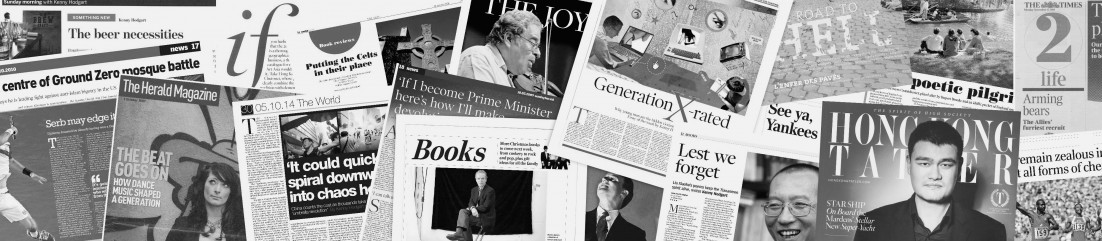
This article was published in Hong Kong Tatler
If there were any doubt that the art world in the 21st Century is a thoroughly globalised, geographically cross-fertilised business, a thumb through the catalogue for this year’s Fine Art Asia quickly dispels it. Local Hong Kong artist Tsang Chui-mei’s paintings very clearly combine the Chinese literati tradition with elements of Western abstract expressionism; Frenchwoman Fabienne Verdier, who spent a decade in China learning traditional ink painting, likewise channels a distinctly East-West spirit on her canvases; and local gallery FEAST Projects’ Chinese Artists in France features works by contemporary master Zao Wouki, who is said to have counted Joan Miro, Picasso and Matisse among his friends once upon a time.
One could go on – but perhaps it was ever thus. Here, for example, we have Galerie Dayan of Paris offering up a large Louis XV vernis Martin – imitation Chinese lacquerware – among its items of French decorative art from the 17th to the 19th Century.
Art fairs in general have about them something of the 19th Century – for Europe a period of global expansion, when, as the hoarding of artefacts and works of art from around the world became almost a competitive sport, major public galleries sprang up, taking art collecting out of its hitherto exclusively private sphere. And Fine Art Asia 2012, which boasts exhibits from across four millenia and confidently straddles Eastern and Western art, is no exception. Indeed, the flaneurs of Haussmann’s Paris might well feel at home at the Hong Kong Convention and Exhibition Centre in Wan Chai next month – were it not for the fact that modern and contemporary art and design sits jowl-to-jowl with that of older vintage.
“I think it’s a perfect match to combine these different strands together in one venue,” says the fair’s founder and director Andy Hei over lunch some weeks ahead of the eighth major international fair he has staged in the city since his first Art and Antiques Fair in 2006.
Hei (who, like his father before him, deals in classical Ming and Qing-era Chinese furniture) and his co-director Calvin Hui (a gallery owner and collector of Asian contemporary art) are bringing together more than 120 galleries from as far apart as London, New York and Singapore for next month’s event – making it the biggest to date and confirming Fine Art Asia as the region’s most prestigious art gathering.
Says Hei: “I come from an antique or heritage art background; Calvin is from the contemporary art world. We’re a small team and we don’t have a lot of resources, so we are basing everything on the position of Hong Kong and our reputation among dealers and buyers.”
The pair are palpably excited, almost skittishly enthusiastic. Hui talks about fluctuations in the market for contemporary Chinese art with the twinkling eye of one who knows what will count as having artistic, and indeed pecuniary, value, years hence; Hei waxes lyrical about Hong Kong’s advantages for art dealers of being a free port and not charging a sales tax on art (it’s little coincidence that the fair coincides with major autumn art auctions in the city). And as a double act they encapsulate what makes the fair work: theirs may be vastly different artistic backgrounds, but they share a belief in the intrinsic value of good art and a passion for bringing as diverse a representation of it together – under the same roof and in their native city.
“Hong Kong has always been the perfect gateway city,” Hei boasts. “It has always known how to deal between East and West. In the art world, it used to be a case of Western buyers buying Chinese art and taking it back to the West; but now you can see the process has changed direction, whereby both Eastern and Western art is moving east.”
With the art market very much driven by wealthy mainlanders right now, Hui believes the Chinese are first of all “buying back” their own heritage: “There is is a phenomenon in China referred to as the Return of Cultural Relics and this is part of that, whether it’s antique art or 20th Century modern Chinese art.”
But it’s not just about patriotism, he insists – mainlanders are also increasingly outward-looking. “Hong Kong has always been in touch with western culture and western art. In China, people are travelling more and going abroad to be educated and there’s a sense that they are experiencing what Hong Kong experienced further back.”
Much like 19th Century European collectors, he says, the nouveaux riches of China are decorating and furnishing their homes with art and artefacts from different centuries and from around the world. “They may not understand the art historical significance of everything but they will think nothing of combining Italian-design furniture from the 1950s with 5,000 year-old Chinese vases, 19th Century English silverware and Ming Chinese paintings.”
Such eclectic appetites are unlikely to be frustrated by the veritable goulash of treasures on show in Wan Chai. The breadth of exhibits at this year’s fair is truly astonishing: Chinese bronzes from the 13th Century B.C; Chinese and Western classical furniture; Asian and international antique ceramics, paintings, jewellery, watches, sculptures, textiles and decorative art; Dutch and Italian landscape paintings from the 17th to 19th Centuries; masterpieces from Pissaro, Sisley, Monet, Renoir, Guillaumin, Picasso and Miro; sculptures by Rodin, Bugatti and Guyot; works by Chinese “new ink” artists Liu Dan Wei Ligang and Qin Fen; vintage jewellery made for the famous 1920s American socialite Millicent Rogers by “jeweller to the stars” Paul Flato; and much else besides.
For his part, Hui is particularly thrilled to be welcoming the first ever 20th Century Italian Design Furniture Exhibition in Asia – which will run for the duration of September, ahead of the fair, at the K11 Art Mall in TST. Presented by Italy’s Novalis Contemporary Art, it features items by masters of modern design including Etorre Sottsass, Gaetano Pesce, Merret Oppenheim and Studio 65. “For so many of us, Italy really defines design,” Hui says. “It is beautiful and regal while still being accessible in everyday life.”
Hei, meanwhile, identifies an expanded fine art jewellery category – spanning antique pocket watches, 19th Century gem-set brooches and Art Deco Cartier necklaces – as a definite highlight.
“An art fair like this is not just a trading platform,” he adds. “It’s an appreciation of design and art history.”
It should also be said that the fair does its utmost to support local artists by allowing students from the Department of Fine Arts at The Chinese University and Hong Kong Art School to showcase, and sell, their work in the hall. “We want to encourage students to stay in the art business,” Hei says. “Hong Kong needs that. It’s a chance for them to get in touch with the real art market.” In addition, Fine Art Asia supports the Hong Kong Society for the Protection of Children and the Hong Kong Cancer Fund, with the latter receiving the proceeds of a charity auction of works donated by local artists.
“My father taught me that if you gain something from the market, you have to give something back,” says Hei. “We’re not just taking Hong Kong as the venue for an art fair, we’re supporting it every way we can.”
All fired up
This article appeared on the South China Morning Post’s Rewind page
Even if you’ve never seen Chariots of Fire, you will have heard its theme: the one that goes “da na na na nah nah” and is usually accompanied on television by footage of people doing things in slow motion. (Come to think of it, the way it has been used as a de facto anthem for British athletics may help to explain why the country’s sprinters no longer win the same quantity of medals as they did, say, at the 1924 Olympic Games, which provide the setting for much of this film.)
Along with The Loneliness of the Long Distance Runner, Chariots of Fire is one of two very fine British films about running and in truth is no more about fire than Slap Her, She’s French. Fire does feature in a number of indirect ways, however.
For one there is a lot of smoking, clearly an aid to sporting achievement in the olden days. Secondly, it features two young men fired up, each in his own way, by zeal or ambition, one of whom, the Scotsman Eric Liddell, has more than a touch of Calvinist fire and brimstone in his makeup. In his unorthodox running style, he also often appears to have a rocket warming his bottom.
Where Liddell is running for God (he even refuses to compete on the Sabbath), Harold Abrahams – the son of a financier who happens to have been a Lithuanian immigrant – is motivated by a desire for acceptance among the echelons of an Establishment, exemplified by the dons at his Cambridge college, that is distinctly sniffy about his Jewishness.
Both are exceptional figures, plucked from real sporting history and held to embody certain virtues – honour, dedication, personal integrity – that infuse the film with a twilit poignance. That theme (composed by Vangelis) and the framing of the flashback narrative with scenes from a 1978 memorial service for Abrahams, add to an overall sense of nostalgia for gifts vanished, lives gone, the flame of camaraderie and love now sputtering or extinguished.
Besides excellent performances from Charleson and Ben Cross (as Abrahams), the supporting credits are chock full with British acting talent, including Sir John Gielgud as one of the dons and a young Nigel Havers in the role of Lord Lindsay, another Cambridge athlete.
There is also much delight to be had from what scholars call the “diegetic” music, i.e that which has a part to play in the narrative itself: plenty of Gilbert and Sullivan (Abrahams’ falls in love with a soprano from The Mikado) and, at the end, a rousing rendition of Jerusalem, the hymn adapted from the William Blake poem which inspires the film’s title with the line “Bring me my chariot of fire”.
The phrase in turn comes from the Old Testament and is taken as a byword for divine energy. Whether or not that idea moves you, Hugh Hudson’s film probably will.
Beyond betrayal
This article appeared on the South China Morning Post’s Rewind page
It may be confidently asserted that the cypher-like emoticon things which nowadays adorn all correspondence amongst people under 30 do not derive their name from George Smiley. The taciturn intelligence officer central to a number of John Le Carré’s most memorable novels, including Tinker, Tailor, Soldier, Spy, is rarely given to emotion, let alone enthusiasm. And with good reason. As Le Carre chronicles, from personal experience, the work of a Cold War spy is painstaking and unglamorous, a quid pro quo only for obscurity, paranoia, possible derangement and almost certain betrayal.
Brought out of forced retirement to hunt a mole (code-named Gerald) whom, it transpires, has effectively turned the Circus – the innermost circle of British secret intelligence – into an arm of Moscow Centre, Smiley is a man betrayed at almost every turn in Tinker, Tailor. Jaded yet loyal, we are led to infer that he feels Gerald’s deception, of the service and of Britain, deeply. That Gerald turns out to be the charismatic Bill Haydon, one of Smiley’s wife’s many lovers, adds further to his martyrdom. And, to top it off, his earlier banishment from the Circus was the price he paid for loyalty to “Control”, the boss ousted after a botched operation which was, it emerges, a trap set up by Haydon and Moscow.
Condensing Le Carré’s intricate storyline is no easy task – as Thomas Alfredson, who directed the recent film version, has attested. But as Smiley burrows deeper into past events – the novel begins in media res and jumps about – he assembles a mosaic of duplicity. Scholars have likened him to Homer’s Odysseus, the scorned outsider putting the kingdom bang to rights, but the Circus’s day of reckoning brings him little satisfaction. And when the final act of revenge, betrayal’s narrative bastard, comes, it is implied the bullet is fired by Jim Prideaux, Haydon’s old partner.
Haydon’s character is derived from Kim Philby, one of the so-called Cambridge Five traitors and the man Le Carré believes blew his own cover as a secret agent. The author knows of what he writes, then: a Britain on whose Empire the sun is setting, exposed to subversion from within the ranks of its own establishment. And the Circus serves almost as an amphitheatre for this attrition of old certainties. Espionage is no game of cricket, certainly.
Still, though, Le Carré manages to convince us of what is at stake: loyalty matters, betrayal of one’s own is contemptible. Smiley clings to a kind of unspoken faith that whatever foulness Englishmen may be capable of in defending British interests, they are still more moral than the other chaps, and that anyway it’s all worth it to uphold the rights of the individual against the tyranny of Soviet communism. In spying on the Circus, he may be “sinning against his own notions of nobility,” but Le Carré leaves us in no doubt that some betrayals are more pardonable than others.
Henry Chinaski’s hangovers
This article appeared on The South China Morning Post’s Rewind page
In committing to print any tribute to Henry Chinaski – the dissipated, rather-more-than-semi-autobiographical anti-hero of Post Office and several other novels by Charles Bukowski – one is faced with two options. The first is to leave the page blank and let the editor explain that the writer was indisposed due to a hangover. The second is to follow Chinaski’s example when he does turn up for work and slog it out, toiling and cursing, cheap liquor oozing from every pore.
So let’s not pay tribute to Chinaski. He has his hagiographers but Bukowski isn’t among them. His characterisation is marinaded in self-loathing; there’s too much hurt and cynicism in him for Chinaski to be in any way laudable. Deadbeats are romanticised in American life from Big Sur to The Big Lebowski, but with Bukowski it’s all too raw. A child of German immigrants to Los Angeles between the wars he was a misfit from a young age. He had chronic acne. His father was abusive. In his early teens he discovered drinking: “This [alcohol] is going to help me for a very long time,” he later recalled. Failing to make it as a writer as a young man, he grew disillusioned and became “a ten-year drunk”, which “lost years” later provided the inspiration for most of his books.
The irony, then, is that unlike Chinaski Bukowski made rather a success of things in the end, but you would have to say it was probably because of rather than despite his love of booze. Alcohol is his muse. It fuels his puckishly dyspeptic view of the world.
Much of Post Office is about the drudgery of work. It covers the period of Bukowski’s own life when he worked as a mail carrier and later a mail clerk, with an interregnum when he gambled on horses. In the novel the US Postal Service is populated entirely by jobsworths, petty bureaucrats and sadistic supervisors; the part of the American dream about bettering oneself through honest sweat gets a literary pulverising. And yet, tempting as it may be to see Bukowski as some kind of champion of the lumpen proletariat, that’s not quite it. Work truly is the curse of the drinking classes in his world. Chinaski drinks when he has a job and when he doesn’t. There is a new hangover roughly every four pages.
Along the way we meet the tragic Betty, a widowed alcoholic 11 years Chinaski’s senior who is based on the love of Bukowski’s life, Jane Cooney Baker, and Joyce, who stands in for Barbara Frye, his first wife, and who is portrayed as a nymphomaniac. Frye divorced him on grounds of “mental cruelty”, which is an apt description of what Chinaski subjects himself to on a daily basis. The problem is that despite being a bum and having next to no redeeming features, he is a uniquely captivating bum. It can rarely be said of man nor woman, but Bukowski’s drinking did the world a service.
No peace in their time
This article was published on The South China Morning Post’s Rewind page
Can peace ever be other than relative? Its scourge, war, enjoins us to believe so: that there exists an opposing absolute to those things which take place on battlefields. All Quiet on the Western Front, written in 1929 by Erich Maria Remarque, a German veteran of the First World War, leaves us in some doubt, however – for to his cast of young recruits, peace is as likely to be attained via the grave as it is by armistice.
To them, we discover, peace is unimaginable, unknowable. As the author states in his short introduction, the book tells of “a generation of men who, even though they may have escaped shells, were destroyed by the war.” Spurred to enlist at 18 by a blustering, jingoistic schoolmaster, Paul Bäumer (our narrator) and his friends are “suddenly old at 20”. Their life experience amounts to having heeded the patriotism of their elders; now, brutalised by life at the front, their numbers winnowed down by Allied bombardments, Bäumer observes “we are a wasteland”, and when his own death arrives he is “almost glad the end had come.”
To read Remarque’s novel almost a century after the events it describes, one is struck not only by a devouring sense of pathos – these soldiers are but boys – but also by how, well, unknowable, the entire conflict seems at this remove. How is it even possible that we can reconcile its apparent meaninglessness or grasp its insanity? The so-called “Great War” was one in which men were sent to their deaths in their millions by commanders-in-chief whose own personal safety was never in doubt, in which those who spoke for peace were silenced and which so knocked the stuffing out of the nations embroiled in it that survivors often chose never to speak of it at all.
That being the case, All Quiet on the Western Front is likely to have been anything but an easy read for many of those who made it an instant international best-seller. Its core message is that war and soldiering are not merely wrong but unnecessary, that the sacrifices demanded of combatants are always in vain. The nihilism is clawing, potent, powerful – but then that is how good writing works. Remarque’s book has been held up to generations of us almost as an article of unimpeachable documentary veracity, which is rather a lot to ask of a novel. Does it explain the war to us any better than history books can? No. Does it make it any more knowable? Almost certainly not.
In the Anglophone world Rudyard Kipling’s homily “lest we forget” is given breath every November. It is the dead we remember, of course, but also the horror and the mystery of wars, in the hope that remembering will forestall more of them. And this, above all, is why All Quiet on the Western Front continues to be read: Paul Baumer may not believe much in peace but Remarque makes us desire it nonetheless.
Interview with Itzhak Perlman
This article appeared in The South China Morning Post’s Review section
For someone so indivisible from the altogether serious business of virtuoso violin-playing – with its exacting levels of self-discipline and its station at the altar of high culture – Itzhak Perlman should, one might reflect, seem rather more daunting than he does. We are, after all, talking about a violinist of real genius: a man in whose hands the instrument has a kind of molten ferocity that distracts from but does not diminish his technical mastery. He is, without doubt, the repertoire’s greatest living interpreter.
But alas, there is nothing daunting, nothing stern, about Perlman – no loftiness or hauteur, no hint of a tortured soul. He may revel in Beethoven and Mahler but he does not share their manic severity. On the contrary, millions around the world love him as much for the enveloping warmth of his personality as for the emotional range of his playing (though the two may be inseparable). Like the late Luciano Pavarotti, he has for decades performed an almost ambassadorial role for classical music, critical adulation combining with the force of his own irrepressible joy in music-making to catapult him into the global popular consciousness.
And so, when he tells me with boyish glee that the last thing to survive when the world ends is certain to be Mozart’s violin sonatas, it is difficult to be persuaded from the notion that Perlman is the effervescent pedagogue we all wish we’d had in school. He is, whisper it, almost as much fun to listen to talking as he is to hear play.
The 66-year-old Israeli-born American, who will perform his first concerts in Macau and Hong Kong for nine years this week, has spoken at length before of how he often asks his students – or when he conducts, entire orchestras – to think about colours or types of food in order to get them to play a piece of music in a certain way. “What do you say to an orchestra that has played, let’s say, Beethoven’s 1st Symphony 200 times? The way I do it is to just try to think of what I would like to hear from a piece, how I hear it in my head.” he tells me. “I would call it suggesting what you want the orchestra to sound like.”
Having taken up the baton relatively late in his career, Perlman has, over the last decade or so, conducted many of the most prestigious orchestras in the US, Europe and beyond. He was, until recently, also Artistic Director and Principal Conductor of the Westchester Philharmonic in New York, where he lives with his wife, Toby. Together, they run the Perlman Music Program, a summer camp for exceptionally talented young string players, and since 1999 he has taught all year round at New York’s Juillard School of Music – the institution at which he himself studied the violin, under the great Ivan Galamian and Dorothy DeLay, after relocating from Tel Aviv in the late 1950s.
“For me these things are all very much connected,” he says. “Teaching and conducting have an effect on you as a performer. Instead of saying to someone they must play a certain way, I talk to myself. I learn to listen in a particular way, so that I can do what I am hearing in the music. Listening is the most important word – the difference between a good performance and an okay performance is in how well the performer listens to what he or she does when they play.”
Perlman’s own students are mostly between 14 and 16. “I can have a better effect on the way they play because they have not developed the habits that older students have picked up,” he says. He is uncomfortable with the phrase “child prodigy”, believing it to create unnecessary pressure on parents and children, but it’s worth remembering he gave his own first recital aged 10 and was soon thereafter performing with the Israeli Broadcast Orchestra.
In reality, he says, he hated practicing and in his reflections on his own youth there is a surprising degree of mixed feeling. He loved the instrument and went through periods of “completely idolising” first Fritz Kreisler and later David Oistrakh. “But I wasn’t sure I could do it [be like them]. You just keep hoping and practicing. If you have talent then people give you support, which I had, but you need an awful lot of negative vibes as well to do this.”
Making things harder, quite probably, was the fact that, having contracted polio at the age of four, he was unable to walk without crutches – to this day he relies on them, and an electric scooter, for mobility, and plays the violin while seated. “People ask me what would I have done if I had not had polio as a young child,” he says. “I really don’t know. I would probably have done the same. When I wanted to play the violin I did not have polio. It was not something that came after.”
In the event, two appearances on the Ed Sullivan Show on CBS in 1958 made him a household name in the US at the tender age of 13, and in 1964 he won the prestigious Leventritt Competition, paving the way for a career touring the world’s concert halls.
Almost five decades later he is the most recorded violinist in history, possesses 15 Grammy Awards and has played with every major orchestra in the world – including the Israel Philharmonic, with whom he made history by going behind the Iron Curtain to perform in Warsaw and Budapest in 1987, and in the Soviet Union in 1990. He has received honorary degrees from Ivy League universities and had successive US presidents clamouring to weigh him down with medals. And in addition he has recorded jazz and klezmer albums, performed as a soloist on the soundtracks to three movies – Schindler’s List, Zhang Yimou’s Hero and Memoirs of a Geisha (along with the cellist Yo-Yo Ma) – and made countless television appearances in the US, including on The Tonight Show and Sesame Street.
A 1980 clip of him performing a Beethoven duet with a tuba-playing Telly Monster can, inevitably, be found on YouTube; not so the 2004 PBS special Perlman in Shanghai, but it chronicles something a little more historic – a visit of the Perlman Music Program to the mainland that culminated in a concert at the Shanghai Grand Theatre featuring one thousand young American and Chinese violinists.
“We linked up with kids from the Shanghai Conservatory,” he says. “Chamber music, certainly a few years ago, did not have the importance there that we feel it should have, so it was one of the things we wanted to promote. But generally in Asia right now, there are a lot of very fine musicians coming through. The ratio of kids coming in from the Far East on our programme is rising – from Korea, China, Japan. It’s really a lot. In the late 1950s, early 1960s, string players tended to come from Europe, Russia maybe, the United States and Israel. Right now the cycle has really shifted to Asia for young string players.”
When I put it to him that he has form in terms of breaking down cultural barriers via music, the response comes back with almost evangelistic certainty: “Music is, simply put, an international language.”
“No matter where I go to play or the culture of that country, when it comes to classical music everybody has a common reaction to it,” he adds. “As an Israeli, there were occasions where I have gone to countries where Israel did not have diplomatic relations yet and you knew that relationships would improve because of those visits with the Israel Philharmonic. The music was a step to improving relations. Because everybody speaks that language.
“There is something about music that is so important to the development of humans. I am asked what I would do without music. I think society would be much worse; it’s the soul of society. What would we do without it?” It doesn’t bear thinking about, of course; but at least the Mozart sonatas are safe.
Silence of the Brahman
This article appeared on The South China Morning Post’s Rewind page
In a sense all books are about silence, which is perhaps one reason why it has long been considered expedient that children take at least a passing interest in them. In the 1960s and 70s, decades after its first publication in 1922, Herman Hesse’s Siddhartha influenced the Beatles and fed into a hippy counterculture that gave off a lot of noise – but there is little point in blaming the water for what grows in the ground: the novel itself, though redolent enough with the German-Swiss author’s own spiritual angst, has a meditative, hushful quality about it in-keeping with its eponymous hero’s search for inner peace, enlightenment and all that sort of thing.
When he wrote Siddhartha, Hesse was living as a semi-recluse and had immersed himself in Hindu and Buddhist scripture in the hope of finding a cure for what he called his “sickness with life”. The result is a version of the bildungsroman – a phrase coined by another German about a century before to refer to novels about difficult young men, more or less – that takes the reader on a walkabout around India in the time of the Buddha and delves rather haphazardly into eastern theology but which must also be read as echoing Hesse’s own quest for self-realisation.
The Siddhartha we meet at the beginning of the novel is a Brahmin’s son who can hold his own in discussion with the wise men of his village and knows “how to say Om silently”. The author does not say as much but he is certainly an unusual boy. Soon he decides to leave his parents and head off in pursuit of nirvana, moshka and various other states of spiritual release the book touches on: first of all by embracing asceticism, which among other bizarre exercises involves occupying the soul of a dead jackal, then later by tasting of a more worldly existence as a trader and lover.
Ultimately, however, it is in quieter rhythms that he discovers “atman”, his true self: by the river, a recurrent symbol of life’s “song”, he meets the ferryman Vaseduva and gains the knowledge he has been seeking from the old man’s “silent love and cheerfulness”.
In the years that followed the First World War – during which Hesse made life difficult for himself by daring to denounce the patriotism he saw as responsible for unleashing hell on earth across Europe – Germany fell into intellectual forment. Hesse was influenced by German romanticism and neo-romanticism, he was intrigued by expressionism, fascinated by the psychoanalytic movement and by orientalism.
And yet, in light of the hell to which -isms would soon return the country it is, in passing, moving to note that Siddhartha effectively renounces the idea of doctrine as a route to harmony. When his old boyhood friend and spiritual accomplice, Govinda, finds him by the river, he wishes to hear what wisdom Siddhartha has finally attained. But the answer is incommunicable – and Siddhartha cannot respond other than with silence.
An interview with Alan Cumming
This article appeared in the magazine Metropolitan
It’s earlyish in the day, but Alan Cumming seems to be in one of his more sombre moods. The Scottish actor, now a joint American and British citizen, is refusing to entertain tittle tattle, certainly. Even his own. “That’s just trashy gossip stuff”, he groans when I bring up his purported desire to see Barack Obama naked.
Regarding the man whose election campaign he endorsed (he was vetted by Team Obama and would have been an “official” supporter but for his citizenship not being approved in time), Cumming said last year: “Great leaders, charismatic leaders […] usually have big penises.” But this morning he’s less declamatory about the US president. “I’m still really, really amazed that he’s president and also really glad,” he says, “but I wish he would act on some of his policies sooner.”
The source of his anguish is gay rights, and in particular the admission of openly gay men and women to the US military, a policy he believes the Obama administration has dragged its heels over: “They’ve made gay people feel like the train is coming, but they’ve not delivered.”
Bisexual himself, though now espoused to his partner of some five years, the graphic artist Grant Shaffer, Cumming is not entirely what you might expect if you had seen him in, say, the National Theatre of Scotland’s production of the Bacchae, as Dionsyus, or in Cabaret, as the Emcee, on Broadway, or indeed in his own cabaret show I Bought a Blue Car Today. Or if you consider that he plays a gender-bending doorman in the movie Burlesque, out this month, and a transvestite in swinging 1960s Soho in The Runaway, a six-part drama that will screen on Sky next year; or that he once launched a fragrance called Scent of Cumming. Sure, he’s camp and occasionally vampy, and he may even indulge in scabrous talk about the presidential appendage, but he’s also strikingly normal, in the down-to-earth sense, considered and pensive; even, at 45, a little shy and boyish at times.
There is, in short, something endearingly straightforward about Cumming and the way he ponders his own experiences and complexities. He is who he is: talented, an actor, a celebrity, Scottish (he retains a pronounced Highland intonation), driven to work, stage or screen, sometimes in “straight” roles, sometimes in roles which are rather less so.
He has, moreover, been doing that work for more than 20 years. After training at the Royal Scottish Academy of Music and Drama, performing as a stand-up comedian and gaining exposure in the Scottish TV soap Take the High Road, he went on to work with the Royal Shakespeare Company and the Royal National Theatre. Before moving into film he was an award-winning Hamlet. On the big screen he has alternated between roles in blockbusters (Goldeneye, X-Men 2, the Spy Kids trilogy) and smaller, independent movies, including Titus (opposite Anthony Hopkins and Jessica Lange), Sweet Land (for which he won an Independent Spirit award as a producer), and last year’s Boogie Woogie and Dare. He has also found the time to co-host his own talk show, with his dogs, moonlight on Broadway, model Lee Jeans and write a Sunday Times best-selling novel, Tommy’s Tale, about the life of a bisexual Londoner having an early mid-life crisis.
And all of that merely scratches the surface of a vast output. Of late, he has been a regular cast member in the CBS legal drama The Good Wife, which has screened on Channel Four in the UK. It’s a fairly straight role – he plays Eli Gold, a smooth, well-tailored political advisor brought in to help a former State’s Attorney relaunch his political career following a corruption scandal – but there is a certain waggishness about the character that suggests there may be more to him than meets the eye. “You get to learn a bit more about him as the current season progresses – a bit about his personal life, his past life, chinks in his armour, that kind of thing,” says Cumming.
Intrigue of a more personal nature gripped him in the summer, however, when he agreed to look into his own family history for BBC One’s Who Do You Think You Are? series. His grandfather, who won a medal for bravery in the British Army’s retreat from France in 1940, and was wounded in battle in Burma later in the war, was an enigma even to his own daughter, Cumming’s mother Mary, who was a child when he died, in 1951, in colonial Malaya. As Cumming was to discover, the circumstances of Tommy Darling’s death were considered so shocking that they were even kept from his wife back home in Scotland: he had shot himself in the head during a game of Russian Roulette.
“Clearly he had been affected mentally by his experiences in the war and they stayed with him and he couldn’t just go back to normal life, which is half the reason he ended up in Malaya,” says Cumming. “The thing I found most galling was that the army just didn’t take combat stress at all seriously. And I think it’s shocking that, even today, in certain circumstances where there is a death that doesn’t involve combat, families aren’t paid compensation.
“It was a pretty devastating thing to discover and my mother found it quite hard to deal with. I think for anyone to find out such a shocking thing about a parent would be hard, but also finding that out and knowing that millions of other people are going to know too, because it’s on television, is a lot to deal with.”
That comes with the territory for her son, of course, but Cumming proclaims an ambivalence towards fame and celebrity that suggests he finds it all a little strange. “There’s a level of self-consciousness that you have to live with,” he says. “You don’t want to draw attention to yourself when you take the dog out for a walk, but it’s there. I’ve learnt that kindness is always the way to respond, but I don’t particularly want to have my photo taken on the street at two in the morning on someone’s camera phone.” He pauses. “At the same time I don’t want to live in a box away from the rest of humanity.”
The tabloids in Britain – Cumming lived in London for many years – tend to be much more invasive than their American equivalents, he says, although Americans obsess more, on the whole, about celebrity. “But it’s getting more like that in Britain as well – the whole thing of people who’ll do anything to be on television seems to be getting more prevalent.”
“I like it when people don’t know who I am,” he adds. “It’s an academic question: if I want to keep doing my job, what do I do? I could go away and hide in the woods, but…”
Doth he protest too much? Maybe, but then on the evidence of his work he is not overly-consumed, as an actor, by his own ratings. “I do feel that I just do what I like,” he says. “Even the things that pay the bills are quite idiosyncratic. I feel I’m on a nice plateau: I get to do interesting work, I get a certain level of access to things because of what I’ve done. I’m content to carry on this way, I’m not on an upward curve of domination.”
If you were being unkind, you might describe the cabaret show he brought to Edinburgh and London in the summer as an ego trip, but he insists it was in fact his most daunting project to date. “I wanted to run away the first time I did it,” he says. “It was terrifying. I’d never stood up before and said ‘this is me, I’m Alan and I’m going to sing a song’. Ask any actor and they would be horrified at the notion.”
The Runaway appealed to him, he says, because of its unconventionality: it’s gangland stuff, but his own character, the transvestite club owner Desree, “is the strongest, the most rational and the kindest person in it.” He has also voiced characters in a spate of animated films this year, including that of “a tranny Hitler” in Jackboots on Whitehall, and appears as Sebastian, alongside the “fantastic” Helen Mirren and a star-studded ensemble cast in a new film version, out this month, of the Tempest. “It’s nice to do Shakespeare for the screen, saying those lines for the camera instead of having to be all bombastic in a theatre.”
Earlier this year the RSC had young actors enact a bizarre six-week-long dramatisation of Romeo and Juliet via Twitter. It would not, alas, have been Cumming’s cup of tea. “I’m not a Tweeter,” he says. “I really don’t think it’s a good thing that people should be sitting commenting on the present at the expense of experiencing the present.” For his own edification he hopes to find the time to write longer dispatches. “I’d like to write a book about things that have happened to me and where I’m from and my life’s course. Not ‘I was born and brought up, blah blah blah’, more short stories about experiences I’ve had.” For this restless, boyish man, the experience, it seems, is all.
 kenny hodgart